New factor in the development of childhood lymphoma
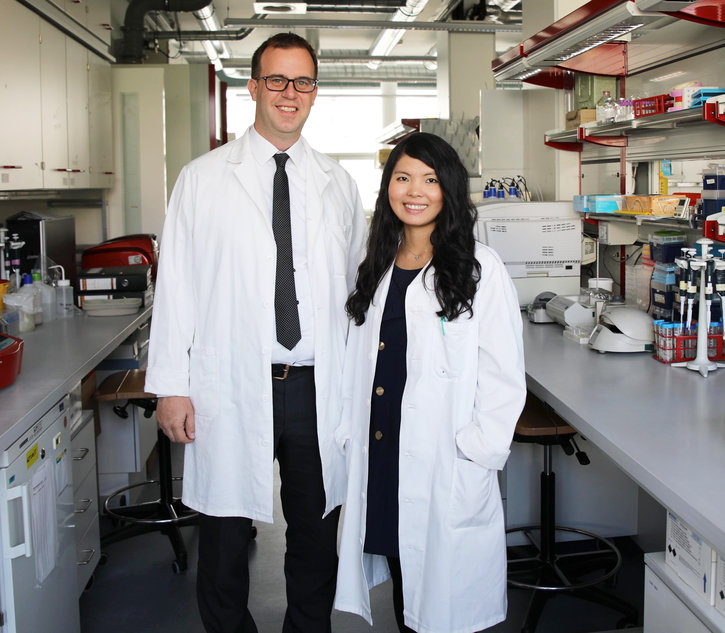
Last author Kaan Boztug and co-first author Marini Thian (LBI-RUD) / © CCRI
The immune system is highly complex and a detailed understanding of many underlying mechanisms is still lacking. Only the precise interaction of a variety of factors guarantees a reliable and correct immune response in a healthy body. Misregulated immune responses are a major cause of a variety of diseases, including cancer, autoimmunity, and immune deficiency. A study recently published in the renowned journal Blood, led by Kaan Boztug investigated four patients from independent families with malignancy, autoimmunity and immunodeficiency. All four patients had a germline mutation in the gene encoding CD137, which led to a dysfunction of the co-receptor protein CD137. This dysfunction impaired crucial factors for immune surveillance, in particular for the prevention of viral infections and the development of lymphoma associated with Epstein-Barr virus (EBV) infection. "Not only did we discover a new tumor predisposition syndrome particularly for childhood lymphomas in this study, we also learned more about the basic function of CD137 in the immune system," says Kaan Boztug, joint corresponding and last author. The study was carried out in a collaboration with scientists from Israel, Germany, Turkey, Colombia, Argentina and the USA. The last authorship is shared by Raz Somech from the Chaim Sheba Medical Center in Tel Aviv, Christoph Klein from the Dr. von Hauner Children's Hospital of the LMU Munich and Kaan Boztug, Scientific Director of CCRI and LBI-RUD, Adjunct PI at CeMM and Associate Professor at MedUni Vienna. Publication & Authors: “CD137 deficiency causes immune dysregulation with predisposition to lymphomagenesis” Ido Somekh*, Marini Thian*, David Medgyesi, Nesrin Gülez, Thomas Magg, Alejandro Gallón Duque, Tali Stauber, Atar Lev, Ferah Genel, Ekrem Unal, Amos J. Simon, Yu Nee Lee, Artem Kalinichenko, Jasmin Dmytrus, Michael J. Kraakman, Ginette Schiby, Meino Rohlfs, Jeffrey M. Jacobson, Erdener Özer, Ömer Akcal, Raffaele Conca, Türkan Patiroglu, Musa Karakukcu, Alper Ozcan, Tala Shahin, Eliana Appella, Megumi Tatematsu, Catalina Martinez-Jaramillo, Ivan K. Chinn, Jordan S. Orange, Claudia Milena Trujillo-Vargas, José Luis Franco, Fabian Hauck, Raz Somech#, Christoph Klein#, and Kaan Boztug#.; published in Blood: blood.2019000644; doi: doi.org/10.1182/blood.2019000644 (* shared first author; # shared corresponding and last author) Funding: The study was funded by the European Research Council (ERC, Consolidator Grant 820074 "iDysChart" and ERC Advanced Grant), the Jeffrey Model Foundation (JMF), the Care for Rare Foundation, the German Research Foundation (DFG, Gottfried-Wilhelm-Leibniz Program, CRC1054) and the Else Kröner-Fresenius Foundation (Research College Rare Diseases of the Immune System). Marini Thian was further supported by a doctoral fellowship from Cell Communication in Health and Disease (CCHD) by The Austrian Science Fund (FWF) and a DOC grant (25225) from the Austrian Academy of Sciences.