Identifying genetic causes for immune diseases as a way to uncover immune regulatory pathways
Human DEF6 deficiency underlies a novel immunodeficiency syndrome with systemic autoimmunity and aberrant CTLA-4 homeostasis
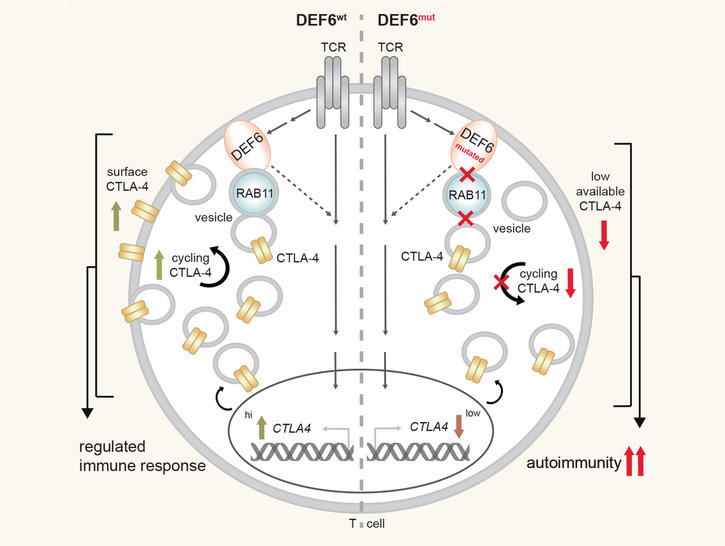
A single gene affected in a young girl resulted in serious autoimmune diseases. By deciphering the underlying mechanism, an international research team led by LBI-RUD Director Kaan Boztug was able to shed some light on the mechanism of autoimmunity in the human body. Based on these findings, an already approved drug has been used to successfully treat the young patient. The researchers uncovered an inborn error of immunity caused by biallelic mutations in DEF6 and characterized by early-onset systemic autoimmunity. They found impaired CTLA-4 availability and trafficking, due to decreased interaction of mutated DEF6 with the small GTPase RAB11, as the mechanistic basis for the autoimmune manifestations. The results of the study were published in the scientific journal Nature Communications.
Immune responses need to be controlled tightly to prevent autoimmune diseases, yet underlying molecular mechanisms remain partially understood. The current work of the Boztug lab underlines the power of identifying genetic causes for immune diseases as a way to uncover immune regulatory pathways. Given the identified role of DEF6 in tuning the immune checkpoint protein CTLA-4, future studies should address whether DEF6 and related proteins are amenable to manipulation for targeted therapeutic intervention in immune-mediated disorders or potentially also anti-cancer immunotherapeutic approaches.
Publication:
Nina K. Serwas*, Birgit Hoeger*, Rico Chandra Ardy, Sigrun V. Stulz, Zhenhua Sui, Nima Memaran, Marie Meeths, Ana Krolo, Özlem Yüce Petronczki, Laurène Pfajfer, Tie Z. Hou, Neil Halliday, Elisangela Santos-Valente, Artem Kalinichenko, Alan Kennedy, Emily M. Mace, Malini Mukherjee, Bianca Tesi, Anna Schrempf, Winfried F. Pickl , Joanna I. Loizou, Renate Kain, Bettina Bidmon-Fliegenschnee, Jean-Nicolas Schickel, Salomé Glauzy, Jakob Huemer, Wojciech Garncarz, Elisabeth Salzer, Iro Pierides, Ivan Bilic, Jens Thiel, Peter Priftakis, Pinaki P. Banerjee, Elisabeth Förster-Waldl, David Medgyesi, Wolf-Dietrich Huber, Jordan S. Orange, Eric Meffre, David M. Sansom, Yenan T. Bryceson, Amnon Altman, Kaan Boztug. Human DEF6 deficiency underlies a novel immunodeficiency syndrome with systemic autoimmunity and aberrant CTLA-4 homeostasis. Nature Communications, 2019, https://doi.org/10.1038/s41467-019-10812-x
Funding:
The study has been supported by the Austrian Science Fund (FWF P24999-B13, P29951-B30, T934-B30), the European Research Council (ERC grant agreement 310857), and the Austrian Academy of Sciences (ÖAW DOC Fellowship 24486).
The Ludwig Boltzmann Institute for Rare and Undiganosed Diseases (LBI-RUD) under the leadership of Kaan Boztug was launched by the Ludwig Boltzmann Gesellschaft in April 2016 together with its partner institutions CeMM, the Research Center for Molecular Medicine of the Austrian Academy of Sciences, the Medical University of Vienna, and the Children’s Cancer Research Institute (CCRI) of the St. Anna Children’s Hospital Vienna.
Related Files
Related Links
Share this article