

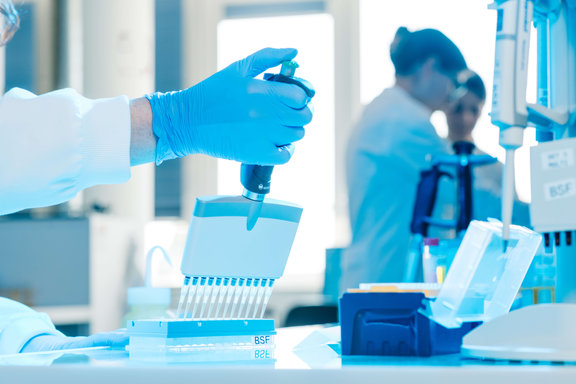
True to its name, the Biomedical Sequencing Facility aims to facilitate access to the sometimes complex next-generation sequencing technology by lowering the entry threshold. We offer both, consulting and hands-on services throughout the experimental workflow from as early as project planning and sampling optimisation, throughout library preparation, sequencing, bioinformatics analyses, data management and submissions to public sequencing data archives prior to publication.
NGS Consulting Services
We are happy to advise and contribute our expertise regarding NGS protocol selection, study design – such as the number of replicates required, how to avoid, minimise or at least allow for the retrospective modelling of batch effects – and the bioinformatic analysis of the resulting data sets. We routinely provide quotes for grant applications.
Library Preparation Services
The BSF offers in-house NGS library preparation for whole-genome, whole-exome, transcriptome, epigenome, and single-cell NGS projects. We routinely provide and review the following NGS protocols but are also open to offer support for assays with lower demand or for custom protocols. Please inquire via bsf@cemm.at.
High-Throughput Single-Cell Assays
- Probe-based sequencing of fixed cells
- Optionally with protein feature (i.e., surface antigen) quantification (CITE-seq) - 3’-expression profiling of live cells
- Optionally with CITE-seq - 5’-expression profiling of live cells
- Optionally with CITE-seq
- Optionally with B-cell receptor (BCR) or T-cell receptor (TCR) sequencing - Single-cell chromatin profiling
- Combination of 3’-expression and chromatin profiling
The starting material are fixed or live single cell suspensions, optionally with antibody staining. All add-on modalities are based on expression information and provide additional measurements for the same cell.
CITE-Seq: Cellular Indexing of Transcriptomes and Epitopes by Sequencing
Classical Transcriptomics
- Strand-specific mRNA shotgun sequencing with UMIs:
PolyA selection
- Suitable for freshly extracted total RNA samples with an RNA Integrity Number (RIN) of 7.0 or better.
Ribosomal rRNA depletion
- Suitable for pre-fragmented or partially degraded sample material such as Formalin-Fixed, Paraffin-Embedded (FFPE) tissue sections. - Strand-specific 3’-transcriptome profiling with PolyA selection and UMIs
- Suitable for larger sample numbers. - Small RNA sequencing
- Low-input PolyA selection (Smart-seq2)
- Suitable for pools of FACS-sorted cells (~200 to 400)
- Suitable for low-throughput singe cell sequencing - Immune profiling via BCR and TCR sequencing
The starting material is extracted total RNA, submitted or shipped on dry ice.
UMIs (Unique Molecular Indices): allow for the discrimination of (artificial) PCR duplicates and genuine molecules in data deduplication and quantification steps.
Epigenomics
- High-Throughput Chromatin Accessibility Profiling
- Methylation Sequencing:
- Enzymatic Conversion (EM-seq)
- Bisulphite Sequencing
Both methods are available either genome-wide (WGBS) or as reduced representation (RRBS) via an MspI restriction enzyme digest.
The starting material is extracted DNA.
DNA Sequencing
- Whole Genome Sequencing
- PCR-free, if ample sample material is available. - Comprehensive Human Exome Sequencing with UMIs:
- Somatic variant calling (tumour and normal)
- Germline variant calling (rare diseases)
Custom Protocols
The BSF is happy to help with the implementation of customised protocols or, if sufficient demand exists, add them to the routine service portfolio. Please inquire via bsf@cemm.at.
Sequencing Services
The BSF has access to a latest high-end NovaSeq X instrument that provides sequencing output at an unprecedented scale and economically competitive per-base-pricing. Its reliable sequencing-by-synthesis NGS technology provides short reads (up to 300 bases in single-end or paired-end configuration) at both, high-throughput and with a low, stochastic error rate (≤ 1x10⁻⁴).
We can also handle smaller short-read sequencing requests and long-read sequencing requests. For special requests and data compatibility with on-going projects, we can still run our older NovaSeq 6000 and MiSeq instruments. The Biomedical Sequencing Facility regularly monitors emergent innovative technology.
A “services and pricing” list is available for download.
